

Using Selfies, Live Streams, and Satellite Images to Save African Elephants
Michael Sommers
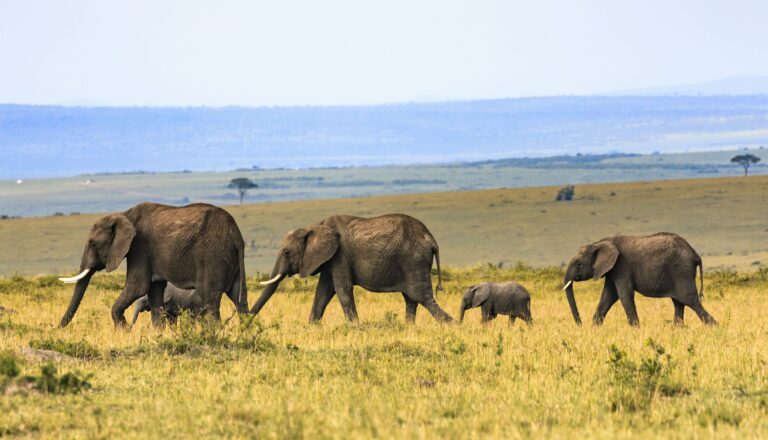
With African elephants so ubiquitous in our collective consciousness, not to mention on our screens, it’s hard to conceive that they’re now officially endangered, having been placed on the International Union for the Conservation of Nature’s Red List of Threatened Species in March 2021.
Over the past century, the African elephant population has plummeted, from an estimated 10 million to 415,000. Habitat fragmentation, human encroachment, and retaliatory killings for crop destruction are major culprits. And despite bans, elephant poaching perseveres, fuelled by an expanding Asian middle class for whom ivory is a status symbol and digital technology that facilitates secret, immediate communications and transactions. However, technology – applied in unexpected and innovative ways – is also becoming instrumental in the fight to save elephants.
For University of Oxford conservation scientist Isla Duporge, accurate monitoring is key to successful elephant conservation. Duporge is part of a research team that’s been using high-resolution satellite images to count elephants from outer space, some 600km from the Earth’s surface. Traditional aerial surveys – in which scientists count elephants from aircraft – can be hampered by poor visibility, fatigue, and double counting. Such inaccuracies are avoided when a computer algorithm does the counting, having been “taught” to identify grey blobs as elephants, even when camouflaged by various backgrounds and lighting situations.
“Satellite images, drones, and GPS tracking are really good at providing accurate data,” says Duporge. “You can track fluctuation in elephants’ movements and behaviour and focus on where to concentrate anti-poaching resources.”
Other conservation hacks depend upon more earthbound technology. In South Africa, the Balule Nature Reserve recently collaborated with Samsung and Africam to create Wildlife Watch, an anti-poaching project where virtual rangers can watch live wildlife videos streamed by camera phones. Aside from a Big Brother-style glimpse into animals’ intimate lives, armchair conservationists can also spot suspicious activities and report them to rangers in the field.
Fighting poachers with movement-triggered camera “traps” isn’t new but using highly sensitive audio sensors to “bug” wild environments, is. The Zoological Society of London (ZSL) and Google Cloud have developed technology that analyses recordings made by acoustic sensors. At distances of up to 1 km, these AudioMoths can pick up sounds such as gunshots and quickly alert the anti-poacher patrols. Cheaper than cameras, the sensors can record continuously for months at a time.
In response to escalating human-elephant conflicts, ZSL conservationists have also been curating elephant “selfies”. As part of a project christened HEAT (Human-Elephant Alert Technologies), they’ve compiled the world’s largest database of some 30,000 thermal elephant images. After being “trained” by the database, thermal cameras are placed in rural communities. When a wild elephant approaches, the camera detects the heat it radiates, alerting residents. Measures can quickly be taken to avoid property destruction, injury, and even loss of life.
Isla Duporge is enthusiastic about these new and ever-evolving technologies – many militaries in origin – being applied to conservation. However, she also warns that tech is no substitute for human beings. “Sometimes there’s too much hype that tech can solve everything. Having well-funded and well-trained rangers who know the landscape really well is crucial, as is getting local communities involved and training them to apply the technologies.”
See also
Arol and Meli: 2 years later, what’s the status of their 3D printer?
Two years after its first report on their 3D printer project in Cameroon, Business Africa reconnects with Harold and his team to explore how their innovation has progressed and the challenges that continue to hold it back. As the team develops a fourth, more precise and advanced model, securing funding remains a major obstacle, despite winning several innovation competitions. Now based in Italy, Harold reflects on the collaboration opportunities that emerged after the first report and the challenges of turning a technical innovation into a commercial business. Meanwhile, his collaborator in Cameroon continues developing the printer, with the ambition of completing the project, bringing it to market, and showcasing the potential of African technological innovation. Journalist : Asha Sumputh
Augustin Doumbe: Opportunities in Africa’s Urban Logistics Industry
In this interview, Initiative Africa speaks with Augustin Doumbe, entrepreneur and founder of Delivery Academy, about the rapid growth of urban logistics and the opportunities emerging across the African continent. Drawing on his experience in transport and last-mile delivery, he discusses the challenges of profitability, financing and professional training faced by entrepreneurs. He also explores the role of women in a traditionally male-dominated industry, the importance of digitalisation, and the future of logistics in Africa. This conversation highlights what it takes to build sustainable businesses and support a new generation of African entrepreneurs in a rapidly evolving sector. Journalist: Asha Sumputh
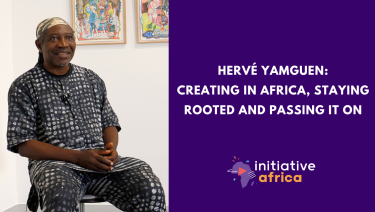
Hervé Yamguen: Creating in Africa, Staying Rooted and Passing It On
In this interview, Initiative Africa speaks with Hervé Yamguen, Cameroonian artist and co-founder of Cercle Kapsiki, about artistic creation in Africa, access to art, and the development of a strong cultural ecosystem on the continent. From his early days in Douala to his international career, he reflects on his decision to continue creating from Cameroon, the importance of bringing art into local communities, and the need for African artists to remain connected to their cultures and roots. He also shares his vision of transmission, identity, and the role art can play in reshaping our relationship with cities, the living world, and the preservation of nature. Journalist: Asha Sumputh
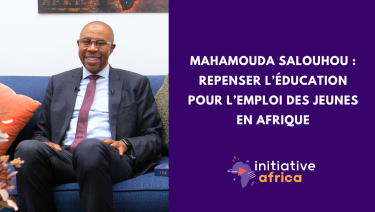
Mahamouda Salouhou: Rethinking Education for Youth Employment in Africa
In this interview, Initiative Africa speaks with Mahamouda Salouhou, professor and researcher specializing in educational innovation and workforce development. Faced with the gap between the number of young graduates entering the African labour market each year and the formal jobs available, he advocates for an approach focused on skills, professional development, and the ability to provide concrete proof of what one can do. From founding universities in Africa to his own personal journey, he discusses how education can better prepare African youth for the world of work and provide them with the tools to turn their potential into real opportunities. Journalist: Asha Sumputh