The Long Road Home for Looted Artworks
Heidi Ellison
It’s long, long overdue, but it’s finally happening: one-time colonizers are beginning to return artworks stolen from their former “possessions”.
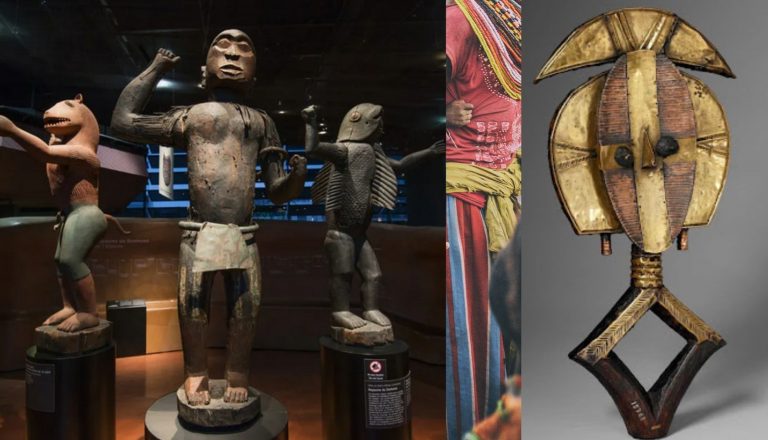
In what is probably the most spectacular and egregious case of theft of artworks by foreigners, during the “British Expedition” in 1897, British soldiers looted over 10,000 artworks and objects after ransacking and burning sacred and royal sites in Edo (now Benin City in Nigeria), the capital of the Kingdom of Benin, and massacring its inhabitants. Collectively known as the Benin Bronzes, these exceptional metal plaques and sculptures were made by Edo artists from the 13th century onward.
Since the British Expedition, these pieces have graced public museums, private collections and art galleries in many Western countries, accompanied by convenient amnesia about how they were obtained. According to Oxford professor Dan Hicks, author of The Brutish Museums: the Benin Bronzes, Colonial Violence and Cultural Restitution, the museums’ possession of these objects makes them complicit in the violence used to obtain them. “No matter how well we tell the story of how these objects ended up in a museum, every day that they remain [there], there’s a re-inscription of that violence,” he said on the podcast “The Haunting History of the Benin Bronzes.” According to Hicks, some 160 museums own pieces looted during the British Expedition.
Following a recent outcry from the African countries concerned and the public, certain museums around the world have somewhat grudgingly begun to return – or promise to return – small numbers of these objects.
The Smithsonian Museum, in Washington DC, has made a commitment to return most of the 39 Benin Bronzes it owns as part of its new “ethical returns” policy, but the deaccessioning of these pieces will first have to be approved by its board of regents. Abba Isa Tijani, director-general of Nigeria’s National Commission for Museums and Monuments, has noted that “we have not encountered another museum that has done as much.”
Little by little, things are moving forward. D.C.’s National Gallery of Art has returned a bronze cockerel to Nigeria, and the Museum of Fine Arts Boston promised in February to send terracotta figures back to Mali. Last November, New York’s Metropolitan Museum of Art returned a few Benin Bronzes to Nigeria.
Also, in November 2022, France’s Quai Branly Museum returned to the Republic of Benin 26 royal objects that had been looted from Abomey, capital of the former Dahomey kingdom, in 1892 by French soldiers. They are currently on display in an exhibition in Cotonou called “Benin Art Yesterday and Today.”
These moves are just a drop in the bucket, however, considering that France alone owns some 90,000 African works, around 70,000 of them held by the Quai Branly Museum.
Belgium, whose Museum de Tervuren owns some 109,000 artifacts from its former colony, the Democratic Republic of Congo, has made a commitment to restitute what could be thousands of objects. Other nations, including Germany, are cautiously considering following France’s lead, and three British universities have already returned a few bronzes from their collections to Nigeria. The British Museum, however, remains the last great holdout, claiming that the preservation of the 928 Benin Bronzes it possesses could not be guaranteed if they were returned.
Now that stolen artworks have started to trickle back to the countries they came from rather than flooding outward as they have in the past, there is some hope that the tide has truly turned and that the museums and other collections holding these looted artifacts will follow the trend – and their consciences – and do the right thing.

Marie-Cécile Zinsou: The restitution of African heritage, “a large-scale movement.”
Twenty-six works of art looted in 1892 from the Kingdom of Dahomey in modern day Benin have finally been returned and are being exhibited in Cotonou. What does it mean for you?
The 26 works are on show in Cotonou; it looks like they really belong in the exhibition in the former presidential palace that has been completely renovated. You walk into the room, and see these 26 works from Abomey, 100 kilometres away, and it is very moving to watch people seeing them for the first time like this, to discover them. The art was here for three months in 2006, but then left again. It is a key moment because it just seems so right. It’s the fruit of a lengthy struggle, like an entire colonial war. It was about the exhibition of these works in Paris for 129 years. Five years fighting over restitution to get France to agree that specific pieces should return to the African continent because it’s been stripped of its heritage. So, what is crazy is that the exhibition feels like it really belongs here in Cotonou and to see the emotional reaction of the public, who find it all perfectly natural. And then to look back over the last five years, the last 130 years and to understand this is the first step of a process to recover a heritage, a part of our history and the fruit of a 130-year-long struggle.
Along with the restitution, a programme of scientific cooperation, scholarships for Beninese heritage students and, above all, the development of the historic site of Abomey have all been announced. Is this the beginning of a new stage in the return of African works of art?
Yes, there is an active museum cooperation between France and Benin, something that exists elsewhere in the surrounding countries, since Germany is cooperating with Nigeria, notably on the question of the return of bronzes from Benin. The Mali Museum collaborates with many museums, including the Brooklyn Museum and the Hamburg Museum. So, something is happening on a European scale and an African scale. It is not just Benin. I think Benin is a bit of a test case with this first necessary restitution. Senegal has also seen the sword of El Hadj Oumar Tall returned to the Museum of Black Civilisations. However, it was just one object. This is really a set of regalia from the ancient kingdom of Dahomey, from the court of Abomey. I think that Benin is a work in progress. All eyes are on Benin to see what will happen. And at the same time, the Benin exhibition allows us to give a master class to all those who have criticised Africa’s ability to care about its heritage. And here we can clearly see what is happening, which is that Benin has been able to exhibit these works in perfect museum conditions, which the public can visit in a perfect setting and that it’s a fantastic success. So, I think how the objects are shown and how the public views them will necessarily lead to different and varied forms of cooperation because people here can finally see it for themselves. After all these silly prejudices, the critics can finally see that Africa does want its heritage back. Africa venerates its heritage and knows how to showcase it.
What do you think of the various solutions being considered? The Democratic Republic of Congo wants to change the ownership of the works while leaving some of them in Western museums. Then there’s the approach that calls for their physical return. What will happen next do you think?
I think we realise Africa is not one big country and that it’s not Europe taking from Africa: that it’s more complex than that. Each country has its history, and each has its history of colonial plundering or the eventual loss of heritage, in very different circumstances. There’s the heritage that’s been sold, there’s the heritage that has been stolen. We know the stories are not the same. If you understand what happened in the kingdom of Dahomey, you do not necessarily understand what happened in the kingdom of Porto-Novo.
And we are talking about two neighbouring kingdoms. So, if you tried to learn what happened in Congo or Mali on what happened in Dahomey, you wouldn’t be able to. Each country has a different dynamic depending on its priorities.
Some countries have complex situations, some on a humanitarian level. I am thinking, for example, of South Sudan, which is not able to build museums because it must prioritise vital infrastructure. So, typically, some countries will not be involved in these heritage issues. But some like Mali, Ivory Coast, Ethiopia, Madagascar, and Chad are all making requests for restitution.
Others, such as Belgium and the Congo, are talking, knowing that the Congo is making reproductions. Belgium isn’t returning art; it’s the Congo that is reconstituting them – which is an exciting way of looking at things from our perspective. Reconstructing your collections means deciding what you want to present to your public. If unique pieces are missing, say are in Belgium, from now on you can ask for them to be given back with the knowledge Belgium has also considered the issue and has decided that all the Congolese heritage in Belgium should become the property of the Congo. Lawmakers are drafting the first bill on returning ownership of the works.
Will all the artworks be returned? Not necessarily. But in any case, the works will belong to the Congo, and Belgium will recognise them as Congolese. Germany is working on a big project on Nigeria’s Edo Museum, with a conglomerate, the Benin Dialogue Group, and with the Hamburg Museum, to go to Edo and help develop the museum with architect Sir David Adjaye in Nigeria.
https://www.adjaye.com/work/edo-museum-of-west-african-art/
Scotland has decided to make restitutions. And even the United States today is returning things they did not plunder as they can’t be accused of being (African) colonialists. These are works they bought, but today feel uncomfortable about, because they know these objects were looted in conditions which can’t be ignored. So, even the United States, which purchased them on the open market, one might suppose with good intentions, is also announcing the restitution of specific pieces. The Smithsonian Museum is a good example as they have identified some pieces to be returned. Today we are in a situation specific to each country, but which is a large-scale movement, because I think everyone in Africa has understood we are interested in our history, our heritage. This is a large-scale movement with specific country by country cases.
Interview by Laurence Soustras
See also
Arol and Meli: 2 years later, what’s the status of their 3D printer?
Two years after its first report on their 3D printer project in Cameroon, Business Africa reconnects with Harold and his team to explore how their innovation has progressed and the challenges that continue to hold it back. As the team develops a fourth, more precise and advanced model, securing funding remains a major obstacle, despite winning several innovation competitions. Now based in Italy, Harold reflects on the collaboration opportunities that emerged after the first report and the challenges of turning a technical innovation into a commercial business. Meanwhile, his collaborator in Cameroon continues developing the printer, with the ambition of completing the project, bringing it to market, and showcasing the potential of African technological innovation. Journalist : Asha Sumputh
Augustin Doumbe: Opportunities in Africa’s Urban Logistics Industry
In this interview, Initiative Africa speaks with Augustin Doumbe, entrepreneur and founder of Delivery Academy, about the rapid growth of urban logistics and the opportunities emerging across the African continent. Drawing on his experience in transport and last-mile delivery, he discusses the challenges of profitability, financing and professional training faced by entrepreneurs. He also explores the role of women in a traditionally male-dominated industry, the importance of digitalisation, and the future of logistics in Africa. This conversation highlights what it takes to build sustainable businesses and support a new generation of African entrepreneurs in a rapidly evolving sector. Journalist: Asha Sumputh
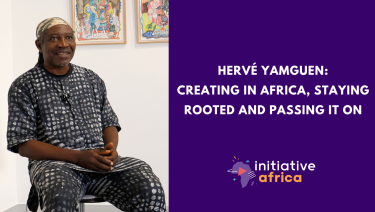
Hervé Yamguen: Creating in Africa, Staying Rooted and Passing It On
In this interview, Initiative Africa speaks with Hervé Yamguen, Cameroonian artist and co-founder of Cercle Kapsiki, about artistic creation in Africa, access to art, and the development of a strong cultural ecosystem on the continent. From his early days in Douala to his international career, he reflects on his decision to continue creating from Cameroon, the importance of bringing art into local communities, and the need for African artists to remain connected to their cultures and roots. He also shares his vision of transmission, identity, and the role art can play in reshaping our relationship with cities, the living world, and the preservation of nature. Journalist: Asha Sumputh
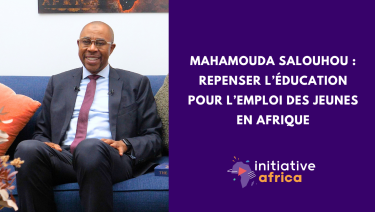
Mahamouda Salouhou: Rethinking Education for Youth Employment in Africa
In this interview, Initiative Africa speaks with Mahamouda Salouhou, professor and researcher specializing in educational innovation and workforce development. Faced with the gap between the number of young graduates entering the African labour market each year and the formal jobs available, he advocates for an approach focused on skills, professional development, and the ability to provide concrete proof of what one can do. From founding universities in Africa to his own personal journey, he discusses how education can better prepare African youth for the world of work and provide them with the tools to turn their potential into real opportunities. Journalist: Asha Sumputh