Sub-Saharan Africa: a landmark architectural guide that Africa deserves

Dandaji, Niger, where a derelict mosque was transformed into a library that shares its site with a new village mosque. | Atelier Masomi, Instagram: @dompublishers
Michael Sommers
Architects Philipp Meuser and Adil Dalbai discuss the challenges involved in producing and editing the recently published groundbreaking Sub-Saharan Africa Architectural Guide.
“If you walk into a kindergarten class in Germany and ask the children to draw an example of African architecture, they’ll draw an adobe hut with a thatched roof.”
Architect Philipp Meuser is discussing one of many insights he and his co-editor and fellow architect, Adil Dalbai, have gained while researching, producing and editing the Sub-Saharan Africa Architectural Guide. Independently financed and published in 2021 by Meuser’s Berlin-based publishing house, DOM, the seven-volume guide is as groundbreaking as it is epic with 200 articles from more than 350 contributors, featuring 850 significant buildings from 49 African countries. To refer to the project – which took over six years to complete – as ambitious is an understatement.
More impressive than the numbers are the discussions the guide has engendered – which is where Meuser’s reference to German kindergartner’s artistic intuitions comes in.
“One of the most surprising things I took away from this project is that even though German colonial history in Africa ended 100 years ago, colonialist terms are still embedded in our language – and we need to erase them.”
Challenging Misconceptions
Adil Dalbai concurs that in the West there are multiple misconceptions surrounding African architecture, beginning with the notion of whether African architecture exists at all.
“More than a single misconception, there’s a fundamental lack of knowledge,” he explains. “Although you have some very specific expertise, most people are very surprised in terms of the fundamentals of how an African city looks, the built realities.”
Of prime importance to the editors is to clear up such misconceptions while promoting a new dialogue on African architecture, including potential solutions for problems ranging from urban sprawl to slum agglomerations. Their guide embraces not only a vast diversity of styles – from traditional and colonial to modernist and contemporary – but also a plurality of voices and backgrounds, from renowned U.S.-based scholars to young local architects working in remote areas of the continent.
A Whole Mosaic
A major challenge was balancing 49 country chapters, each with its own authors, each ultimately comprising an autonomous book within a book. Says Dalbai, “We didn’t want to harmonize the voices, but we did want the guide to have a clear structure so that readers don’t get lost amid the 3,400 pages.”
The desire to make a beautiful guide with striking images that would appeal to laypeople posed further challenges. “It wasn’t always easy to get high-quality images,” admits Dalbai. “South Sudan, for example, is in the midst of a civil war. In other areas, it’s prohibited to photograph public buildings and police control is strict.” Dalbai says that he and several other contributors were arrested. “Sometimes it took some persuasion,” he adds.
With such a wealth of material, the editors added an extra volume, a theoretical and historical overview of contemporary architecture across the continent, unprecedented in its scope. Previous works about sub-Saharan African architecture have “just been fragments of the mosaic,” says Meuser.
“Although we didn’t fully succeed in revealing a whole mosaic in its entirety, we hope others will be motivated to continue with similar projects. That’s what Africa deserves.”
Copies of the Sub-Saharan Africa Architectural Guide will be donated to African architecture schools and their libraries via the Architecture is Free Foundation, providing students with free access to the guide.
The Sub-Saharan Africa Architectural Guide is also currently available for purchase via DOM’s webshop for 198 Euros (excluding shipping).
See also
Arol and Meli: 2 years later, what’s the status of their 3D printer?
Two years after its first report on their 3D printer project in Cameroon, Business Africa reconnects with Harold and his team to explore how their innovation has progressed and the challenges that continue to hold it back. As the team develops a fourth, more precise and advanced model, securing funding remains a major obstacle, despite winning several innovation competitions. Now based in Italy, Harold reflects on the collaboration opportunities that emerged after the first report and the challenges of turning a technical innovation into a commercial business. Meanwhile, his collaborator in Cameroon continues developing the printer, with the ambition of completing the project, bringing it to market, and showcasing the potential of African technological innovation. Journalist : Asha Sumputh
Augustin Doumbe: Opportunities in Africa’s Urban Logistics Industry
In this interview, Initiative Africa speaks with Augustin Doumbe, entrepreneur and founder of Delivery Academy, about the rapid growth of urban logistics and the opportunities emerging across the African continent. Drawing on his experience in transport and last-mile delivery, he discusses the challenges of profitability, financing and professional training faced by entrepreneurs. He also explores the role of women in a traditionally male-dominated industry, the importance of digitalisation, and the future of logistics in Africa. This conversation highlights what it takes to build sustainable businesses and support a new generation of African entrepreneurs in a rapidly evolving sector. Journalist: Asha Sumputh
Hervé Yamguen: Creating in Africa, Staying Rooted and Passing It On
In this interview, Initiative Africa speaks with Hervé Yamguen, Cameroonian artist and co-founder of Cercle Kapsiki, about artistic creation in Africa, access to art, and the development of a strong cultural ecosystem on the continent. From his early days in Douala to his international career, he reflects on his decision to continue creating from Cameroon, the importance of bringing art into local communities, and the need for African artists to remain connected to their cultures and roots. He also shares his vision of transmission, identity, and the role art can play in reshaping our relationship with cities, the living world, and the preservation of nature. Journalist: Asha Sumputh
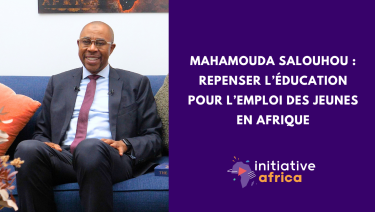
Mahamouda Salouhou: Rethinking Education for Youth Employment in Africa
In this interview, Initiative Africa speaks with Mahamouda Salouhou, professor and researcher specializing in educational innovation and workforce development. Faced with the gap between the number of young graduates entering the African labour market each year and the formal jobs available, he advocates for an approach focused on skills, professional development, and the ability to provide concrete proof of what one can do. From founding universities in Africa to his own personal journey, he discusses how education can better prepare African youth for the world of work and provide them with the tools to turn their potential into real opportunities. Journalist: Asha Sumputh